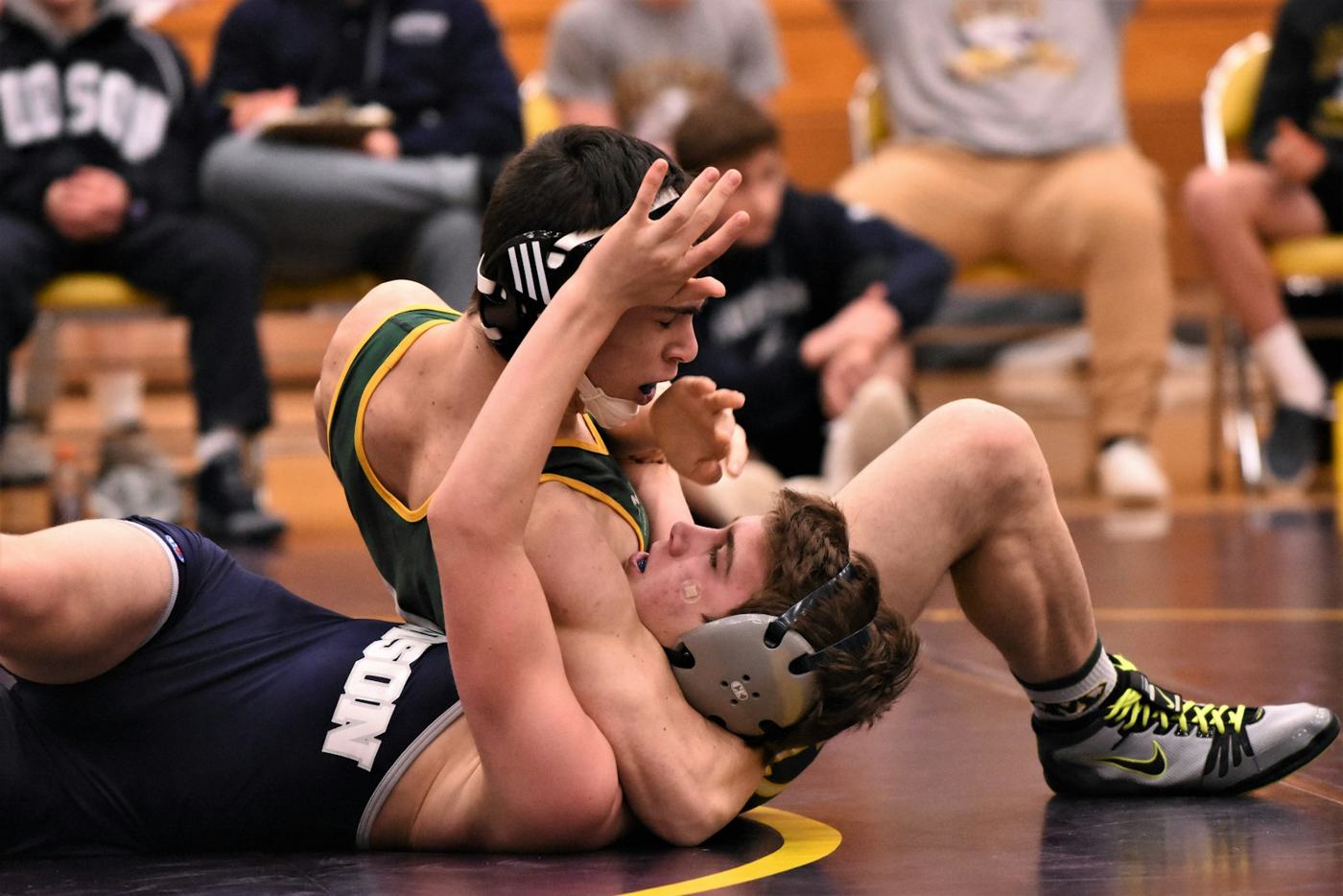
NCAA wrestling has separate weight classes for men’s and women’s college competition. Men’s wrestling has 10 weight classes, from 125 lb through heavyweight at 285 lb NCAA men’s rules. Women’s wrestling also has 10 weight classes, from 103 lb through 207 lb NCAA women’s rules.
NCAA wrestling weight classes for men and women
| # | Men (lb) | Men (kg) | Women (lb) | Women (kg) |
|---|---|---|---|---|
| 1 | 125 | 56.7 | 103 | 46.7 |
| 2 | 133 | 60.3 | 110 | 49.9 |
| 3 | 141 | 64.0 | 117 | 53.1 |
| 4 | 149 | 67.6 | 124 | 56.2 |
| 5 | 157 | 71.2 | 131 | 59.4 |
| 6 | 165 | 74.8 | 138 | 62.6 |
| 7 | 174 | 78.9 | 145 | 65.8 |
| 8 | 184 | 83.5 | 160 | 72.6 |
| 9 | 197 | 89.4 | 180 | 81.6 |
| 10 | Heavyweight 183 to 285 | 83.0 to 129.3 | 207 | 93.9 |
Sources: NCAA men’s rules book and NCAA women’s rule book 2026-27. Kilograms converted. Women at 207 lb must weigh at least 146 lb.
These are the college wrestling weight classes used in NCAA competition. The men’s and women’s divisions have different class limits, so make sure you are looking at the correct table.
Each listed weight is the upper limit for that class. If you are choosing a college weight class, start with your normal training weight instead of the lowest number you think you could reach.
Your goal is to find a class where you can compete well, recover between matches, and maintain your strength throughout the season.
Keep these questions in mind when looking at the tables:
- Current weight: Where does your normal, well-hydrated weight fall?
- Training: Can you practice hard and recover at your planned class?
- Schedule: How will travel, competition, and recovery affect your routine?
- Certification: Does your planned class fit your team’s weight management assessment?
- Performance: Would competing at a higher class help you feel stronger?
If you are moving from high school into college wrestling, do not assume your old weight class has a direct match. Compare the college divisions with your current body weight and discuss your options with your coaching staff.
NCAA heavyweight and 207 lb minimum weights
The upper weight classes work differently from the lighter divisions because they also have a minimum entry weight.
In NCAA men’s wrestling, heavyweight covers 183 to 285 lb, and a wrestler must weigh at least 183 lb to compete in that class NCAA men’s rules.
For NCAA women’s wrestling, the 207 lb class requires a wrestler to weigh at least 146 lb NCAA women’s rules.
Rule check: For the top men’s and women’s divisions, pay attention to both the lower entry limit and the upper class limit.
This matters when a wrestler is moving into the highest division. You need to consider more than whether you can stay below the maximum weight.
Being eligible for a division also does not mean it is automatically your best competitive choice. A lighter wrestler may prefer to compete in a different class depending on strength, training weight, and team needs.
If you are near the lower entry limit, talk with your coach before changing your body weight. Building a sustainable training routine is a better starting point than trying to force yourself into a class.
When do NCAA wrestlers weigh in?
College wrestling weigh-ins happen close to competition. Knowing the schedule helps you plan meals, hydration, travel, and recovery.
The main NCAA weigh-in timing rules:
- Men and women: Weigh-in scheduled no more than 2 hours before competition
- Default timing: 2 hours before competition unless coaches agree on a shorter interval
- Men’s teams: No more than 1 team weigh-in per day
- Men’s 2-day team-advancement tournaments: Missing weight on day 1 prevents weighing in on day 2
The time between the scale and your match matters. You need to be ready to wrestle, not simply focused on seeing the correct number.
Ask your coaching staff when and where your official weigh-in will happen. Check the event schedule rather than relying on what happened at a previous tournament.
Have your normal meals and fluids planned around the competition schedule. Bring appropriate food and drinks so you can refuel after weighing in.
Safety: Do not stop drinking water or skip meals to force a lower reading. Dehydration and under-fueling can leave you feeling weak when it is time to compete.
If you are consistently struggling to make your class, discuss whether the class is appropriate rather than repeating a difficult cut before every event.
NCAA wrestling 1 pound weight allowance rules
Some college wrestling events include a weight allowance. The allowance depends on the type of competition and how the events are scheduled.
| Competition situation | Weight allowance |
|---|---|
| Back-to-back team competition | 1 lb on the second day |
| Dual meets within 48 hours | 1 lb for the later event |
| Multiple back-to-back team events | Maximum 1 lb total |
| Multi-day tournaments | 1 lb for each consecutive competition day |
The distinction between back-to-back team events and multi-day tournaments matters. Do not assume the same allowance calculation applies to every schedule.
Before traveling, ask your coach which weight limit will apply at each weigh-in. Confirm whether the competition is a dual meet, a sequence of team events, or a multi-day tournament.
A weight allowance is not a reason to plan a more aggressive cut. It changes the applicable limit for an eligible event, not what your body needs for training and recovery.
If you are close to your class limit, prepare for the official weigh-in rather than relying on an allowance you have not confirmed.
Keep your target weight, expected weigh-in conditions, and recovery routine clear before competition day.
Banned weight loss methods in NCAA wrestling
NCAA men’s wrestling rules prohibit several methods used to force rapid weight loss.
Prohibited methods and practices include:
- Laxatives, emetics, and self-induced vomiting
- Hot rooms, hot boxes, and steam rooms
- Saunas during the wrestling season
- Diuretics
- Vapor-impermeable suits, including rubber and neoprene suits
- Artificial rehydration during competition
Safety: These are not shortcuts to making weight. They can be dangerous, and the prohibited methods have no place in a wrestling weight management plan.
Do not confuse losing water with making meaningful progress toward a sustainable competition weight. A lower scale reading is not useful if you arrive at your match exhausted or unable to perform normally.
Avoid last-minute attempts to change your weight through extreme heat, dehydration, or purging.
Instead, work with your coaching staff on a realistic class choice, regular meals, normal hydration, and adequate recovery.
If making weight repeatedly requires extreme measures, reassess the target class. The goal is to compete at a weight your body can maintain without sacrificing your health.
College vs high school wrestling weight classes
College and high school wrestling use different class systems. The weight class that fits you in high school may not have the same name or limit when you reach college.
For a broader comparison, see the wrestling weight classes guide.
If you compete in girls’ high school wrestling, the girls wrestling weight classes page can help you compare your current divisions with the NCAA women’s lineup.
The move to college wrestling is a good time to reassess your competition weight.
Your body, training load, and team role may change. Rather than automatically choosing the closest college class below your current weight, consider where you can train consistently and perform well.
Weight certification also deserves attention. Your preferred division and your assessed minimum wrestling weight are different considerations.
Use the NCAA weight certification calculator to estimate a minimum wrestling weight and explore which college class may fit.
The calculator is a planning aid. Discuss your results with your team’s coaching and athletic training staff before making decisions about changing weight.
What to do next before your NCAA wrestling season
Once you know the college weight classes, focus on finding a sustainable competition weight and building a routine around it.
A useful preparation checklist:
- Check your normal weight. Use your usual hydrated training weight as your starting point.
- Choose a realistic division. Think about strength, recovery, and the way you feel during practice.
- Review certification. Understand your assessed minimum weight before committing to a class.
- Confirm weigh-in details. Ask your coach about the official schedule and any applicable allowance.
- Plan regular meals. Eat enough to support training instead of relying on last-minute weight changes.
- Protect hydration. Keep drinking water normally throughout training and preparation.
- Prepare for recovery. Have food and fluids ready for after the scale.
For a more detailed approach, read how to cut weight for wrestling safely.
You can also use the CutCoach app to build a day by day plan for calories, water, meals, and refueling after the scale based on your weight, weight class, and weigh-in date. It is available on iPhone and Android.
Your weight class should support your wrestling, not control your entire training routine.
The best starting point is a class you can maintain while eating, drinking, practicing, and recovering normally. If your target requires constant struggle, talk with your coach about choosing a different division.