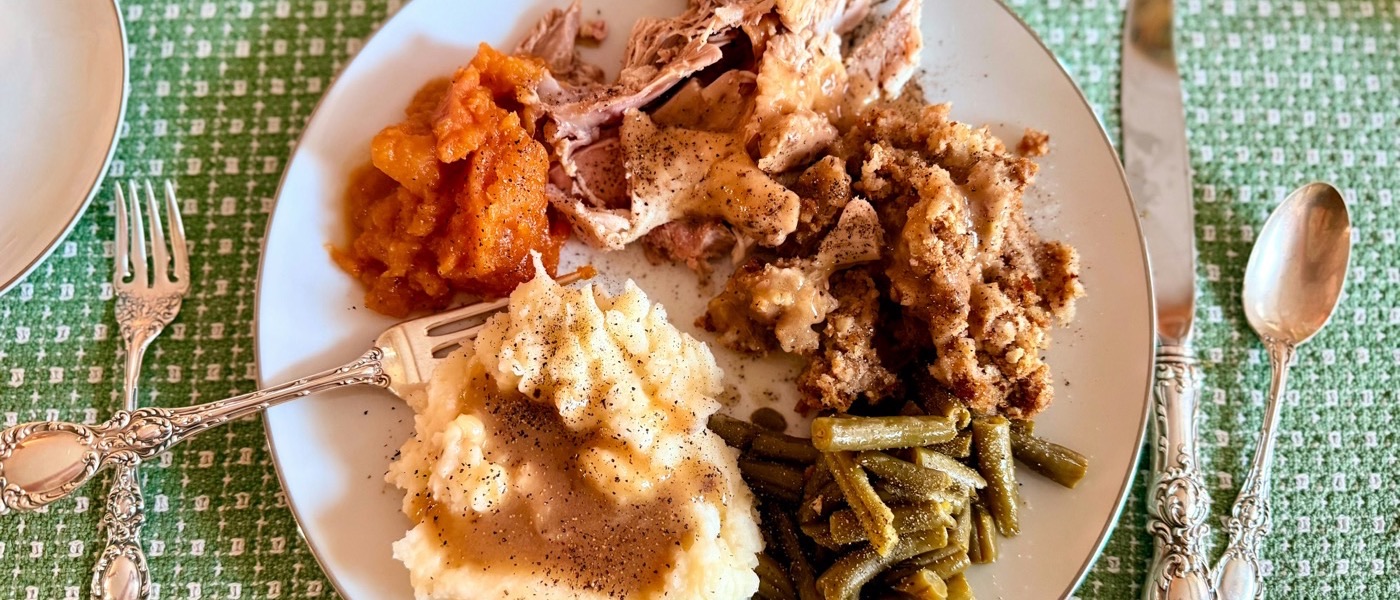
Your scale may jump a few pounds after Thanksgiving, mostly from undigested food and water, not new fat.
How much weight do you gain on Thanksgiving?
A full Thanksgiving plate weighs about 2.4 lb before digestion, or about 4.2 lb with seconds. USDA FoodData Central Across the whole holiday season, adults gained only about 0.8 lb on average, not the commonly claimed 5 lb. Yanovski et al., NEJM 2000 For a 145 lb wrestler, that larger meal is about 2.9% of body weight, almost twice the 1.5% weekly weight-loss limit. High school weight management rules
Food on a plate and weight lost across a week are different measurements, so this is only a sense of scale. The point: the meal is not extra fat, and you should not try to sweat its weight off before a Friday weigh-in. A higher morning reading is information, not an order to cut weight.
What is in a Thanksgiving plate?
| Food | Portion | Weight (g) | Calories | Carbs (g) | Sodium (mg) |
|---|---|---|---|---|---|
| Turkey, light meat with skin, roasted | 6 oz | 170 | 301 | 0 | 172 |
| Stuffing, from mix | 1 cup | 200 | 390 | 38 | 958 |
| Mashed potatoes, milk and butter | 1 cup | 210 | 237 | 35 | 666 |
| Turkey gravy | 1/2 cup | 119 | 61 | 6 | 687 |
| Cranberry sauce, canned | 1 slice | 57 | 91 | 23 | 3 |
| Green beans, boiled, salted | 1 cup | 125 | 44 | 10 | 299 |
| Dinner rolls | 2 rolls | 56 | 174 | 29 | 262 |
| Pumpkin pie | 1 slice | 133 | 323 | 46 | 318 |
| One full plate | 1,070 | 1,620 | 187 | 3,363 | |
| Plate + seconds (turkey, stuffing, potatoes, gravy, pie again) | 1,902 | 2,932 | 313 | 6,163 |
- A full plate has about 1,620 calories and 3,363 mg of sodium. Adding seconds brings it to about 2,932 calories, 313 g of carbs, and 6,163 mg of sodium. USDA FoodData Central
- Stuffing, mashed potatoes, and gravy bring much of the sodium in this meal.
- Turkey has almost no carbs, unlike most of the sides and dessert.
Why does the scale jump the morning after Thanksgiving?
The scale does not tell you how much fat you gained at dinner. It weighs your whole body, including food that has not yet passed through your digestive system and water your body is holding.
| Reason | What happens |
|---|---|
| Food is still in your gut | The food on your plate had real weight before you ate it. Some of it is still being digested the next morning. |
| Carbs bring water into muscle | Your muscles store carbs as glycogen. Each gram of glycogen is stored with at least 3 g of water. Fernandez-Elias et al., 2015 |
| Salt helps retain fluid | Sodium from food or drinks helps your body hold on to fluid. Sports nutrition position statement |
You cannot tell these apart by looking at the scale alone, and there is no reason to turn the next morning into an emergency weight cut.
How much weight do people really gain over the holidays?
Average change from before Thanksgiving to January, in three studies:
Data: Yanovski et al. 2000 (New England Journal of Medicine), Yoo et al. 2025 (Obesity Science & Practice), Kaviani et al. 2019 (Obesity). Averages; some people gained more, some lost.
Yanovski and colleagues tracked 195 adults and found an average gain of about 0.8 lb from mid-November to January, much less than the common 5 lb claim. Yanovski et al., NEJM 2000 Their small net gain was still there the following fall. That is a reason to keep steady habits across the season, not a reason to fear one dinner.
Yoo and colleagues measured 47 college students before Thanksgiving break and after they returned in January. Average weight went up about 1.6 lb, while lean mass increased and body fat percentage did not change. Yoo et al., 2025 A change in body weight does not always mean the same change in body fat.
Kaviani and colleagues studied 111 adults: people who weighed themselves daily, viewed a weight graph, and aimed to stay at their starting weight had no meaningful holiday gain, while the control group gained about 5.8 lb and still kept 57% of it 14 weeks later. Kaviani et al., 2019
In-season wrestlers often step on a scale most days, so that part may sound familiar. But these were adults in a holiday study, not wrestlers making weight. The useful lesson is to watch the pattern over time instead of making a drastic decision after one large meal.
What should wrestlers do on Thanksgiving week before a weigh-in or tournament?
Eat Thanksgiving dinner. Do not skip breakfast to save room for it, and do not skip meals afterward as punishment. You still need regular food and water while you train and get ready to compete.
If you have a weigh-in soon after Thanksgiving, build your plate from the foods in the table:
- Put turkey and green beans on your plate first.
- Add a scoop of stuffing and mashed potatoes. You do not have to avoid the sides.
- If your weigh-in is close, go easy on seconds of stuffing, potatoes, and gravy. Those items bring much of the meal’s salt.
- Keep drinking water with dinner and through the next day. Do not try to change your weigh-in number by avoiding fluids.
If Friday morning is higher than expected, remember that Thursday’s food and water can still affect the reading. Continue normal meals and your scheduled practice, and check your weigh-in requirements and your existing weight plan. Read Water Weight Before Weigh-In for more on what the scale is measuring.
Rule check: High school weight management rules limit weight loss from the initial assessment to 1.5% of body weight per week, or about 2.2 lb per week for a 145 lb wrestler. High school weight management rules NATA position statement This is a ceiling, not a weekly goal. The weight of Thanksgiving dinner is not weight you should try to cut on Friday.
Safety: Never use extra sweat workouts, saunas, sweat suits, or rubber or plastic suits to make weight. Never stop drinking water, fast, or skip meals to force the scale down. The CDC reported three deaths among college wrestlers attempting rapid weight loss, including one after prolonged weight-loss exercise, with rhabdomyolysis listed as the cause. CDC MMWR
Before competition, check Wrestling Weigh-In Rules so you know what applies at your event. Use the Descent Plan Calculator to look at your weight-class plan rather than reacting to one morning reading.
How do wrestlers get through holiday break without losing their weight class?
Keep your normal meal rhythm during the break and stick with the training your team has planned. Do not use a day off as a reason to stop eating or to make up for a holiday meal.
In college athletes, a usual winter break brought little change in body fat, while a break about 3 weeks longer was linked to more fat mass in men; muscle mass did not change in either group. Dommel and Sayer, 2022 The length of the break and your routine matter more than a single dinner.
Some weight gain can also be lean mass, not fat, as the college student study showed. Yoo et al., 2025 If you are training well, that is not a reason to panic about the scale.
If you are still bringing weight down, do not cut your food below the ISSN combat sports minimums of 3.0 to 4.0 g/kg carbohydrate, 1.2 to 2.0 g/kg protein, and 0.5 to 1.0 g/kg fat per day. ISSN combat sports position stand For more, read How to Cut Weight Without Losing Muscle.
What should you do next after Thanksgiving?
Use your next weigh-in as a check on your existing plan, not a reason to start a crash cut. Look at your weight class, weigh-in date, normal meals, and training schedule together.
The CutCoach app builds a day by day plan with calories, water, meals, and refueling after the scale, based on your weight, weight class, and weigh-in date. That gives a holiday meal a place in the plan instead of making it feel like the plan is broken.
See the Wrestling Diet Plan for everyday eating and the Descent Plan Calculator to check the path toward your class.