How much weight do you lose in a wrestling practice?
Young wrestlers lost an average of about 1.3 lb, or 0.96% of body weight, during a 90 minute wrestling session in a published study Demirkan et al.
Your result may be higher or lower. Body size, how hard the practice is, room temperature and how much you drink all change the number on the scale.
Most of the weight you lose during practice is water, not fat. It comes back as you rehydrate. The calculator above uses your own before and after weights to estimate how much you sweated and how fast you lost fluid.
The study followed 14 male wrestlers ages 14 to 16, averaging about 134.8 lb. An endurance session dropped them an average of 1.17 kg (1.89%) and a circuit strength session 0.85 kg (1.39%), and urine got more concentrated after every type of training Demirkan et al.
Use your result to plan your drinking, not to set a weight cutting target.
How does the sweat loss calculation work?
The difference between your before and after weights is your net body weight change. It is not your total sweat loss.
If you drank during practice, some of that water replaced sweat before your second weigh-in. If you used the bathroom, that fluid was not sweat.
The calculator adjusts for both. It adds what you drank and subtracts urine, following the National Athletic Trainers’ Association method NATA
Sweat loss formula:
Sweat loss (L) = weight before (kg) - weight after (kg) + fluid drunk (L) - urine (L)
Sweat rate (L per hour) = sweat loss (L) / practice time (hours)
In pounds and fluid ounces:
Sweat loss (fl oz) = (weight before - weight after, in lb) x 15.3 + fluid drunk (fl oz) - urine (fl oz)
How to weigh yourself for an accurate number
Do it the same way every time:
- Use the bathroom before your first weigh-in.
- Use the same scale before and after practice.
- Wear the same dry clothing, or minimal clothing, both times.
- Know how much you drink. A bottle with ounce marks makes this easy.
- Note any bathroom trips during practice.
- After practice, towel off and take off wet clothing.
- Weigh right away, before you eat or drink anything.
- Before practiceWeigh inUse the bathroom first. Same scale, dry, minimal or the same clothing.
- During practiceTrack drinksKnow your bottle size and count refills. Note any bathroom trips.
- Right afterWeigh againTowel off sweat, same clothing, before you eat or drink.
- Next few hoursDrink back125% to 150% of the weight you lost, spread out, with some salt.
Method from the NATA fluid replacement position statement (2017). Drink-back range from the 2016 sports nutrition joint position (Academy of Nutrition and Dietetics, Dietitians of Canada, ACSM).
Worked example: how much water weight did you lose?
Say you record these numbers:
- Before practice: 152.0 lb
- After practice: 149.6 lb
- Fluid drunk: 16 fl oz
- Urine: none
- Practice length: 90 minutes
Step 1: Scale change. 152.0 - 149.6 = 2.4 lb, which is 1.09 kg.
Step 2: Fluid you drank. 16 fl oz = 0.47 L.
Step 3: Total sweat loss. 1.09 L + 0.47 L = 1.56 L. That is about 53 fl oz, or 3.4 lb of sweat.
Your scale dropped 2.4 lb, but you actually sweated about 3.4 lb, because you replaced some fluid while you wrestled.
Step 4: Sweat rate. 90 minutes = 1.5 hours. 1.56 L / 1.5 hours = 1.04 L per hour, about 35 fl oz per hour.
Step 5: Body weight change. 2.4 / 152 x 100 = 1.6%. That is under the 2% warning line.
Step 6: Drink-back range. 125% to 150% of the 2.4 lb you lost is 1.36 to 1.63 L, about 46 to 55 fl oz. Spread it over the next few hours instead of drinking it all at once.
Is your sweat loss a problem?
The number to watch is your body weight change, not your total sweat.
The 2016 sports nutrition joint position reports sweat rates of 0.3 to 2.4 L per hour (about 10 to 81 fl oz), and warns that fluid deficits above 2% of body weight can hurt thinking and aerobic performance, while losses of 3% to 5% more often hurt high intensity effort and sport skills Sports nutrition position
ACSM says the goal of drinking during exercise is to prevent dehydration greater than 2% of body weight, with a plan built around your own sweat rate ACSM
What does 2% of body weight look like?
| Starting weight | 2% of body weight |
|---|---|
| 106 lb | 2.1 lb |
| 120 lb | 2.4 lb |
| 138 lb | 2.8 lb |
| 152 lb | 3.0 lb |
| 175 lb | 3.5 lb |
| 215 lb | 4.3 lb |
These are warning lines, not goals.
Safety: If you often finish practice more than 2% below your starting weight, talk to your athletic trainer about how much you drink during practice.
Your sweat rate shows how much fluid you lose per hour. In the example it was about 35 fl oz per hour. That is a measurement, not an order to drink that exact amount every hour.
What if you gained weight during practice?
A higher weight after practice means you drank more than you lost through sweat and urine.
NATA says you should not gain weight during exercise unless you started with a fluid deficit you could not avoid, and it warns that drinking too much can cause exercise-associated hyponatremia, a dangerous drop in blood sodium NATA
If the scale shows a gain, check how you measured your drinks first. Do not try to fix it by sweating more. Ask your athletic trainer to look at your drinking plan.
How much should you drink after wrestling practice?
Your drink-back range is based on the weight you are still down after practice, not your total sweat loss.
The joint position recommends drinking 125% to 150% of the fluid deficit after exercise, about 20 to 23 fl oz per pound lost, and says sodium from food or drinks helps your body hold on to that fluid Sports nutrition position
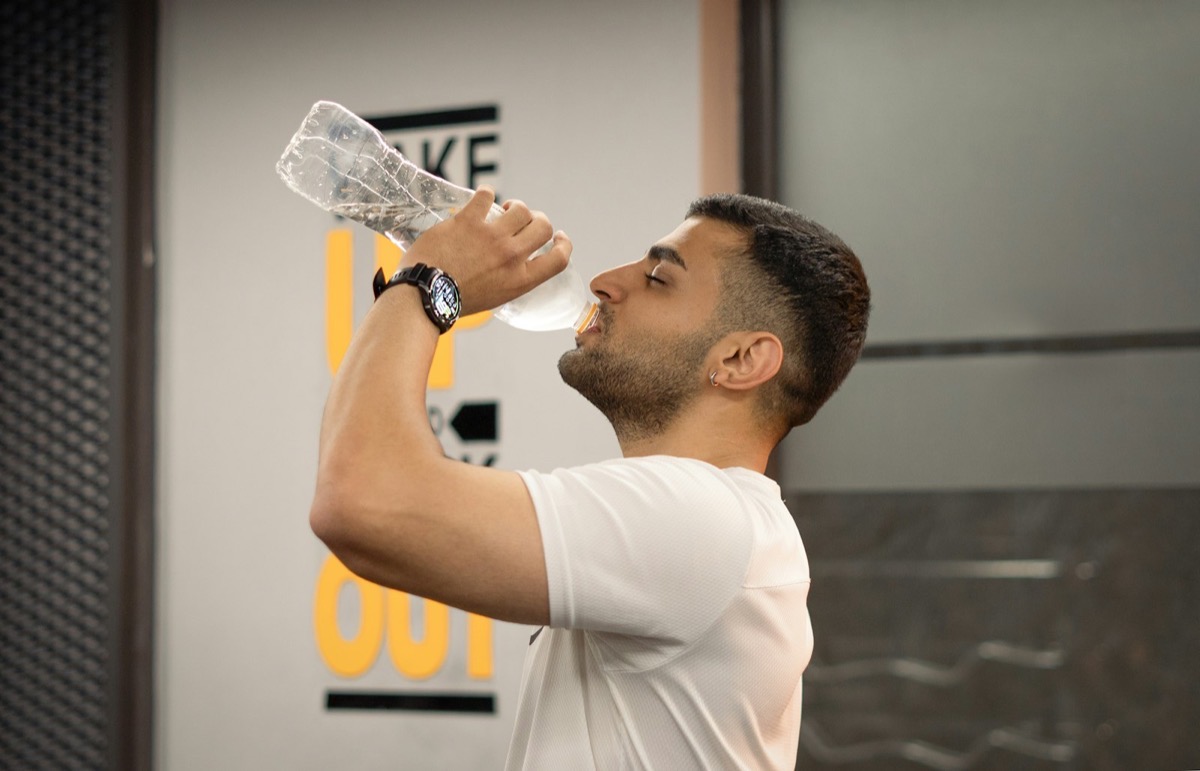
Sip it over the next few hours. Eat a normal meal with some salt in it, especially after a heavy sweat. Do not cut salt to keep the scale lower.
On competition days, use the rehydration calculator to plan fluid and refueling after a weigh-in.
Common sweat loss calculator mistakes
- Weighing in wet clothing: a soaked singlet or wet shoes makes your after weight look higher and hides some of the loss.
- Forgetting what you drank: drinks during practice count toward your sweat loss, even if the scale still went down.
- Ignoring bathroom trips: urine is not sweat. Use the optional urine field when you can measure it.
- Calling the drop fat loss: the post-practice drop is mostly water. It is not real progress toward your weight class.
- Using one hot practice as your normal rate: heat and hard sessions change how much you sweat. Compare a few practices.
- Trying to sweat more: extra layers, sweat suits and holding back water make the number useless and put your health at risk.
Safety: NFHS says excessive food and fluid restriction, sweat suits, hot rooms or boxes and steam rooms should be prohibited NFHS
What should you do next?
Use your results to drink better during training. Do not use them as a plan to sweat down before a match.
Rule check: The ISSN position on combat sports says athletes with same day weigh-ins, such as wrestlers, may need to rely more on body fat loss and lean mass management than on acute water loss to make weight ISSN
- What to eat before wrestling practice covers the meals and snacks that fuel training.
- How to pass the wrestling hydration test explains why you should never cut water before your test.
- Water weight before a weigh-in explains why water lost before a weigh-in is hard to get back before you wrestle.
- The weight cut calculator compares your current weight with your target class.
If you are working toward a class this season, CutCoach builds a day by day plan for calories, water, meals and the refuel after the scale, from your weight, weight class and weigh-in date. It is on iPhone and Android, rated 4.8 from 1,600+ App Store ratings.
This free tool gives an estimate from public rules. Your official numbers come from your coach, your state association or your event. Nothing you type here is sent to us or saved.
Sources
- NATA position statement: Fluid replacement for the physically active (2017)
- Nutrition and athletic performance: AND, Dietitians of Canada and ACSM joint position (2016)
- ACSM position stand: exercise and fluid replacement (2007)
- Demirkan et al. (2025): acute effects of different training types on hydration in young wrestlers
Not medical advice. Talk to your coach, athletic trainer or doctor before changing how you eat or drink. CutCoach does not recommend saunas, sweat suits, diuretics or skipping fluids to make weight.